
How to Change a Song's Keyfor Your Vocal Range
To change a song's key to fit your voice, move the track one semitone at a time. First test the highest and lowest difficult passages. Once you have two or three workable options, sing the entire song in each one. Choose the key where your voice has the best balance of comfort, tone, consistency, and expression, not simply the highest key you can reach.
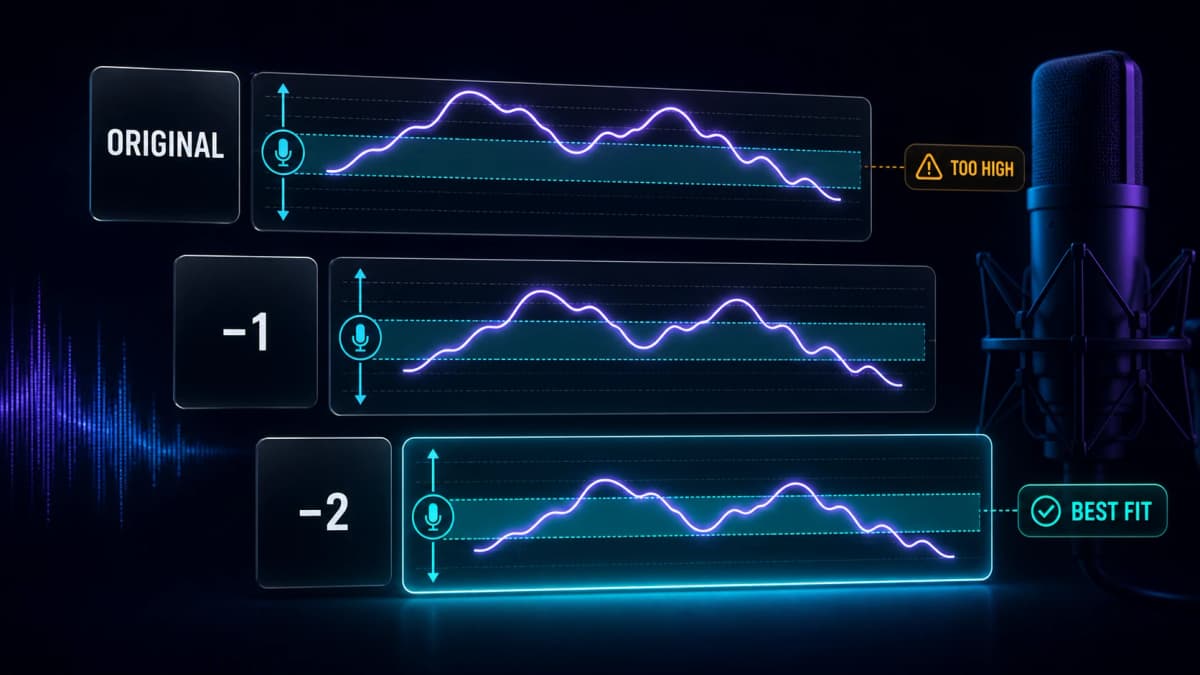
That last step matters. Lowering a song may fix its high point while making the verse too low. Raising it may strengthen the low notes but place the chorus in an awkward part of your voice. The best performance key has to work across the whole song.
What changes when you change a song's key?
Changing a song's key, or transposing it, moves every note by the same musical distance while preserving the melody's shape. A semitone (also called a half step) is the smallest interval used in standard Western musical notation. On a piano, it is the movement from one key to the next, including black keys. Open Music Theory explains half steps and whole steps in more detail.
If you lower a track by one semitone, every vocal and instrumental note moves down by one semitone. Lower it by two, and every note moves down by two. The melody remains recognisable, but it sits in a different place in your voice.
This is different from changing speed. Pitch controls how high or low the song sits. Speed controls how quickly it plays. Keeping those controls separate lets you choose a comfortable key and a useful learning tempo independently.
Signs that the current key may not fit your voice
A song can be technically possible while still being a poor performance fit. Listen for problems at both ends:
- The highest phrases repeatedly feel like survival rather than singing.
- Lower passages lose clarity, presence, or reliable pitch.
- A register transition lands in an awkward place again and again.
- One section sounds good, but your tone changes noticeably elsewhere.
- You can complete the notes once, but cannot repeat the performance consistently.
- The effort required leaves too little attention for timing, phrasing, or expression.
Range is only part of this decision. Voice teachers also consider where most of a song sits, register transitions, vocal weight, and colour when matching repertoire to a singer. A National Association of Teachers of Singing presentation on repertoire fit evaluates high notes, low notes, register transitions, overall ease, and vocal weight, not maximum range alone. See the NATS presentation.
You do not need to calculate all of that before singing. A structured comparison will reveal most of what you need.
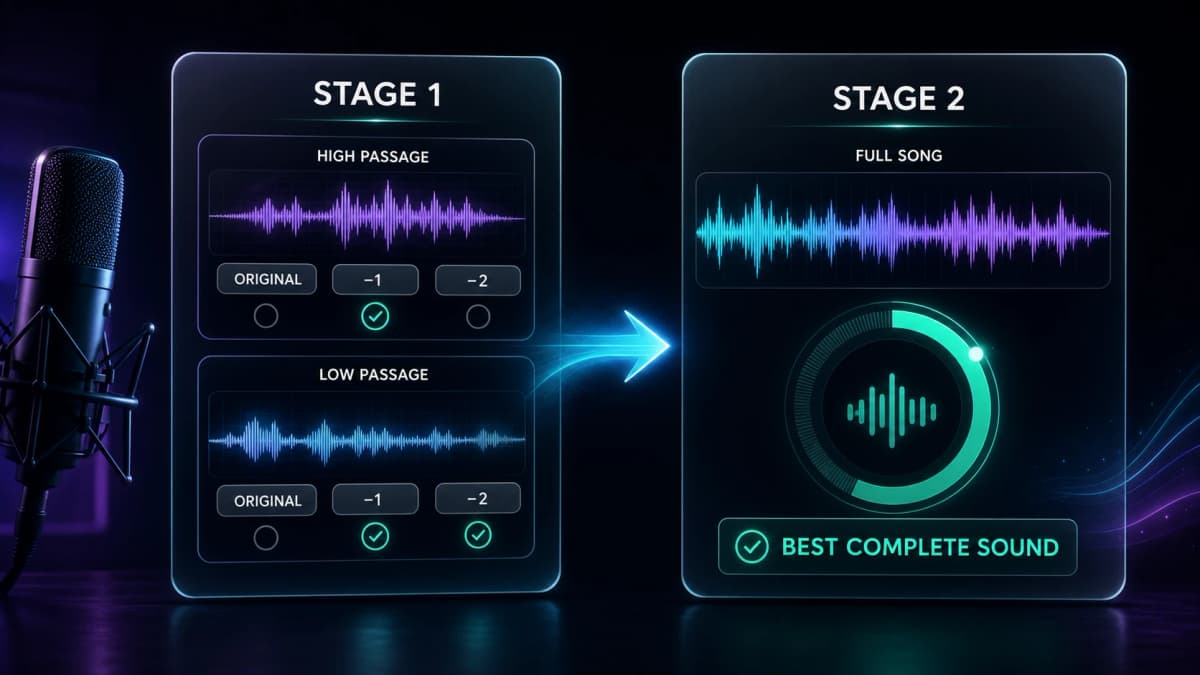
Stage one: shortlist keys using the difficult passages
Start with the exact recording or practice track you intend to use. A live version, cover, or alternate arrangement may sit differently from the studio recording.
1. Choose one high passage and one low passage
Select the section that gives you the most difficulty near the top of the song and another near the bottom. Do not test only the biggest chorus note. The key has to support both ends.
If the original is too high, begin at −1 semitone. If it is still uncomfortable, try −2. If the song is too low, use the same process upward at +1 and then +2. Small changes make it easier to hear what actually improved.
2. Keep the melody and octave consistent
Sing the same passages in the same intended octave for each test. Otherwise, you may think a key fits simply because you changed the melody's placement by an octave.
3. Notice more than note accuracy
For each candidate, ask:
- Can I sing the high phrase without losing the tone I want?
- Does the low phrase remain clear and stable?
- Do register transitions feel predictable?
- Can I repeat the passage consistently?
- Can I still shape the phrase instead of concentrating only on reaching it?
Keep the two or three settings that perform best across both passages. This is only the shortlist, not the final answer.
Stage two: sing the entire song
Now perform the complete song in every shortlisted key. This catches problems a short test cannot reveal: a verse that stays too low for too long, repeated high phrases that become inconsistent, or a bridge that crosses your registers awkwardly.
Use the same simple scorecard after each version:
| What to compare | Question to ask |
|---|---|
| High passages | Can I repeat them with the tone and control I want? |
| Low passages | Do the notes remain clear and present? |
| Register transitions | Do the changes feel manageable throughout the song? |
| Consistency | Does the key still work near the end? |
| Expression | Can I focus on the performance instead of fighting the notes? |
| Overall sound | Does this version sound like my voice at its best? |
Do not automatically select the highest surviving option. A higher key may be possible after enough practice while a slightly lower one still produces a better performance.
What I learned while practising "Perfect"
While learning "Perfect" by Ed Sheeran, I struggled with some of the higher passages even though the original singer is also male. That was a useful reminder: a singer's gender does not tell you whether a particular recording will fit your voice.
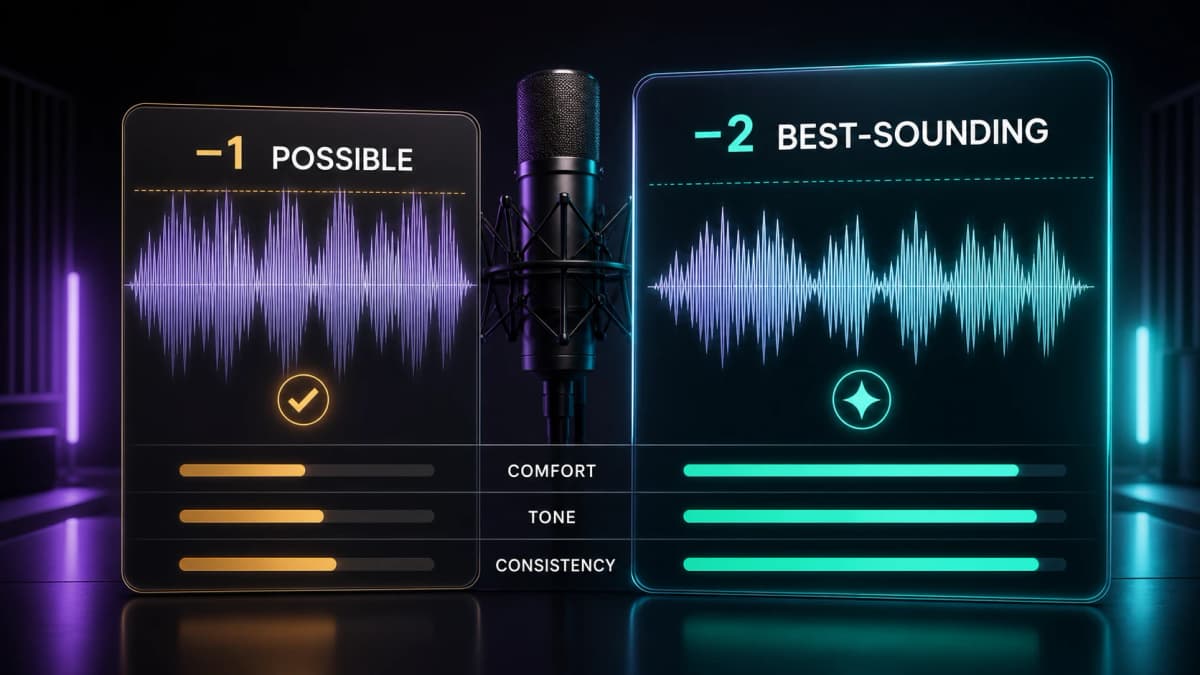
I started practising the song two semitones lower and slowed it to 0.90×. That setting gave me enough space to study the performance and work through the difficult sections. After more practice, I became able to sing it at −1, but −2 still gave me better comfort, tone, and vocal quality.
The lesson was not that −2 is the correct setting for this song. It was that possible and best-sounding are different decisions. My voice could eventually manage the higher option, but the whole performance still worked better for me at −2.
I also wanted to hear the original vocal more clearly. I used Singers AI Vocal Isolation to create a vocal track and an instrumental track. Without drums and instruments masking the details, I could focus on the vocal notes, timing, and small melodic movements. Slowing the vocal made those details easier for me to study, and singing with it made my own pitch or timing mistakes more obvious.
After working on the difficult sections, I applied the same −2 setting to the instrumental. That gave me a customised karaoke practice track in the key I had chosen for my voice.
Vocal isolation is optional. You can use the key-testing method with any suitable recording or practice track you have the right to use. It helped my learning process, but it is not required and will not produce the same result for every singer.
Reproduce the test in Song Practice Workspace
Singers AI Song Practice Workspace keeps pitch and speed as separate controls. Pitch moves from −6 to +6 semitones; speed moves from 0.70× to 1.30× in 0.05× steps. Your pitch, speed, and loop setup can be retained for the next practice session.
Use it for the two-stage test:
- Add the exact practice track you plan to sing with.
- Leave speed at 1.00× while comparing keys, unless you are also learning the melody.
- Move the pitch by one semitone.
- Test the highest and lowest difficult passages.
- Shortlist the settings that work at both ends.
- Sing the complete song in each shortlisted setting.
- Choose the version with the best overall comfort, tone, consistency, and expression.
- If you are still learning details, slow the chosen version separately without changing your pitch decision.
- Save the setup you want to practise again.
Workspace does not calculate the best key or choose one for you. It gives you controlled versions of the same track so you can listen, sing, and make the decision yourself.
Common mistakes when changing a song's key
Choosing from the highest note alone
The highest note may become easier while the rest of the song falls into a weak or dull part of your voice. Always include a low passage and a full-song test.
Moving several semitones immediately
Large jumps can skip over a better nearby option. Begin with one-semitone changes unless you already know the song needs a substantial shift.
Assuming a male or female original should fit you
Two singers of the same gender can have different ranges, comfortable areas, register transitions, and preferred tone. Test the recording rather than relying on the label.
Confusing pitch with speed
Lowering the playback speed helps you study timing and melodic detail. Lowering the pitch changes where the song sits in your voice. Use each control for its own purpose.
Treating one successful attempt as the answer
A performance key should remain workable across repeated passages and the complete song. Compare consistency, not only the best attempt of the day.
Build the version that fits your voice
The original recording gives you a starting point, not an instruction. Test nearby keys in small steps, check the hardest high and low phrases, then sing the complete song. Choose the version where your voice sounds most comfortable, consistent, and expressive, even if you can technically sing it higher.
Build a practice version that fits your voice.
Test nearby keys in small steps, compare the whole performance, and keep the pitch and speed setup you want to practise again.
Explore Song Practice Workspace