
How I Learned to Sing Bollywood Songs, Notes First
When I started, I did what most people do. I picked a Bollywood song I loved, played it, and tried to sing along. It never really worked. Some parts sounded close, most did not, and I could not tell which was which. I was copying the singer, not actually learning the song.
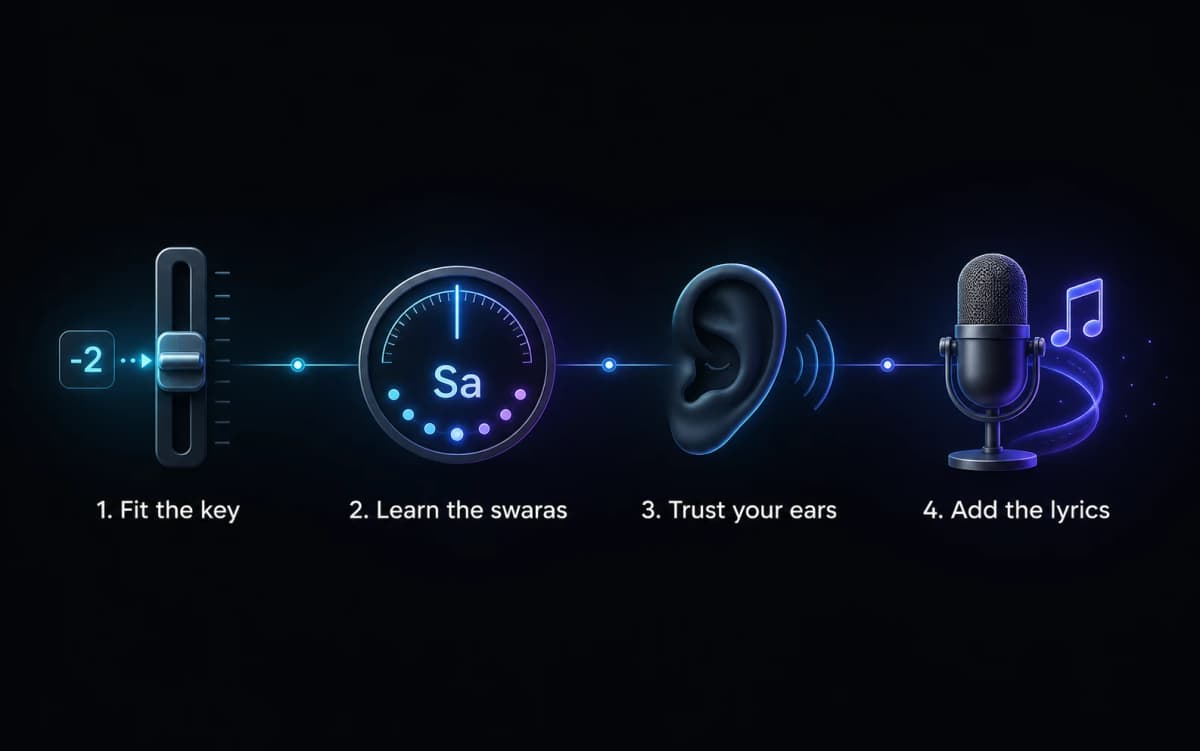
Stage 1: put the song in a comfortable key
My teacher's first rule was to move the song into a key that sits comfortably in my voice before learning it. I applied that rule to "Kal Ho Na Ho" using a phrase-by-phrase Sargam notation tutorial from Sargam Zone. The tutorial shows the song in C♯, but the original or tutorial key is not a rule. The song has to sit in a comfortable part of my voice before I start learning it.
I used the Song Practice Workspace to move my practice track down two semitones, from C♯ to B. That −2 change put the melody where I could practise it properly instead of forcing myself to copy the tutorial's scale. This was Workspace's job: give me the song in the right key and let me practise against that track. It was not checking which swara I sang.
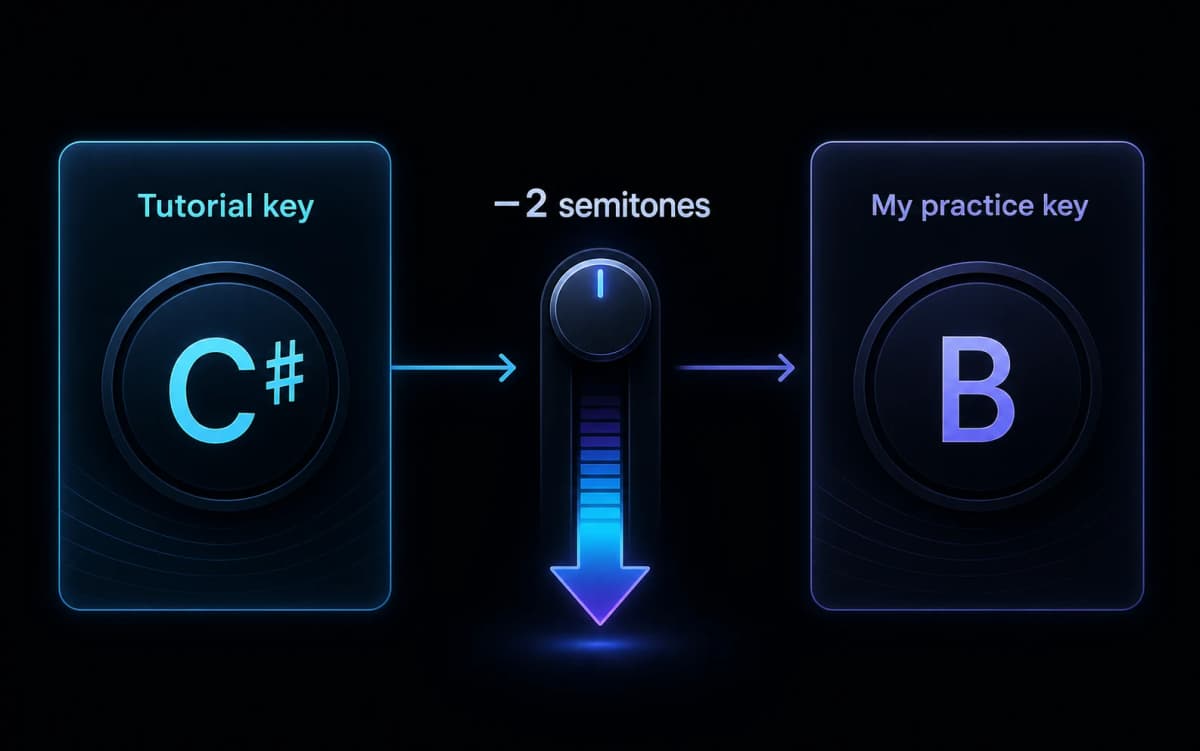
If you follow this example, use the video to understand the notation, then use only an audio practice track you own or have the right to use in the Song Practice Workspace. Move it one semitone at a time until the melody sits comfortably. I explain that process more fully in the guide to changing a song's key to fit your voice.
Stage 2: learn the notes, not the lyrics
My teacher's second rule surprised me: learn the notes before the lyrics. Forget the words for now. Sing the whole melody as swaras, the note names, and nothing else.
The Sargam Zone tutorial gave me the notes phrase by phrase. Instead of singing the words of a line, I sang only its notes. As a made-up example of the idea, a short phrase might come out as "Ga Ga Re Re Sa Re" (this is just an illustration, not the actual song). Every line became a small string of notes like that.
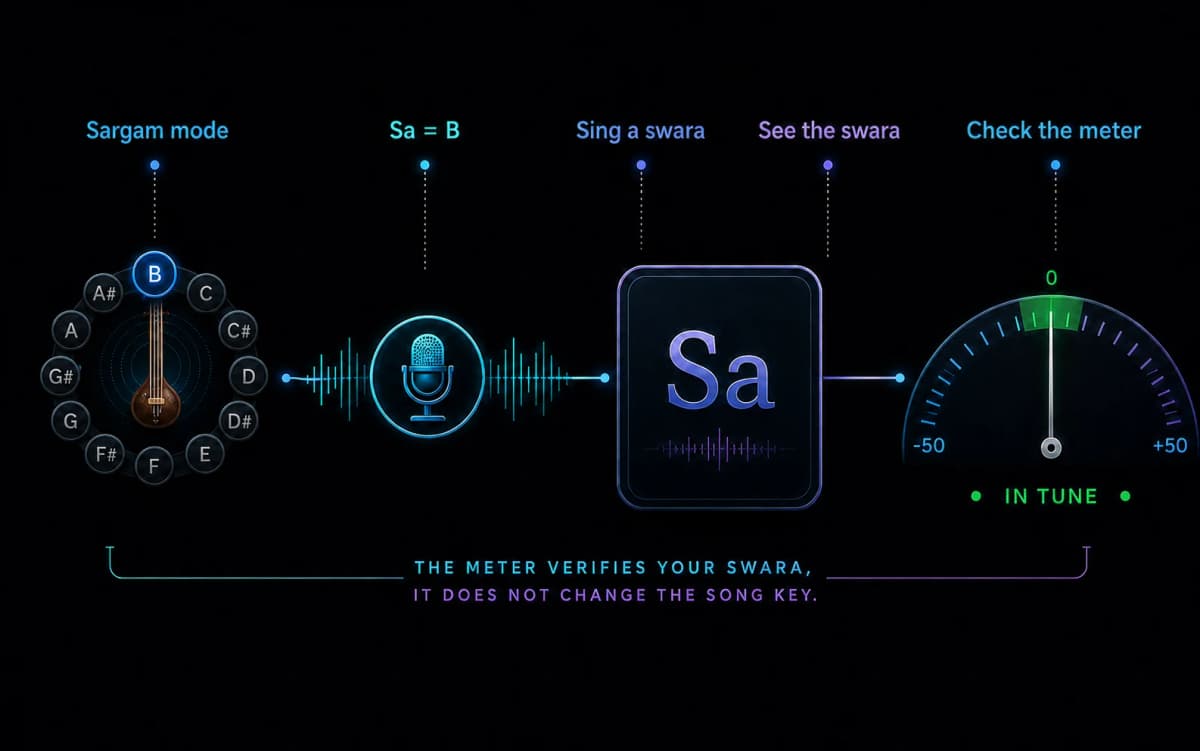
Workspace and the tuner had two separate jobs in this method. I used Workspace to prepare and practise the song in B. Then I opened the Vocal Tuner, switched it to Sargam mode, and set my Sa to B. That let me check whether the swaras I was singing matched the notes I was practising with the Workspace track.
Here is exactly what I did in Sargam mode:
- I started the Tanpura drone, which followed the Sa I had set to B.
- I sang each swara from the notation. I could see the swara clearly on the tuner meter and check whether I was landing on the right note.
- If the meter showed a different swara or that I was not landing cleanly, I corrected the note and tried it again.
- Once I could hit every note in the phrase cleanly, I sang the whole melody in swaras, with the correct rhythm and flow, still no words.
If you are new to the swaras, start with what sargam is and the daily alankar patterns first. And if you are not sure whether you are landing the notes, the guide on telling whether you are singing in tune walks through reading the meter.
Keep it simple: tuner first, then your ear
Here is the honest part. As a complete beginner, this was all I needed, and all I could handle: the B key/scale practice track in Workspace, then the Tanpura and the Vocal Tuner in Sargam mode for checking the notes. Nothing else.
I did not touch any advanced tricks early on. They would not have helped me then, because I could not yet tell a right note from a wrong one by ear. Workspace had already put the track in my comfortable key, and the Sargam-mode meter could show whether I was singing the intended swara. That was enough. Trying to do more would only have confused me. If you are starting out, resist the urge to pile on techniques. Get the notes clean first.
The tuner was never meant to be something I watched forever. At first, I needed it because I could not reliably tell whether a note was right. But after practising the same notes for some time, I changed the exercise: I closed my eyes, sang the note against the tanpura using only my ears, and checked the meter only after I had committed to the note.
If the tuner agreed, I knew my ear was learning. If it did not, I corrected the note and tried again. That became the real progression for me: use the tuner to learn the note, then let your ear lead and use the tuner only to check.
The goal is not to depend on a meter for every note. The goal is to train your ears until you can recognise and reproduce the note yourself.
Stage 3: add the lyrics, then perform
Only once I could sing the full melody in notes, cleanly and in rhythm, without needing to watch the tuner for every note, did I return to the B track in Workspace and add the words.
This part felt easy compared to the first stage, and that is the whole point. Because the notes were already in my voice and my ear, I was not fighting the melody and the words at the same time. I just laid the lyrics onto notes I already knew. After that came actually performing it: singing it with feeling, at full speed, like a song and not an exercise.
Slow and loop difficult phrases when you need to
For Kal Ho Na Ho, fitting the key came first. Moving the tutorial's C♯ down to B gave me the practice key before I started fixing the notes.
The same Workspace also has two controls that can help when a phrase needs more work:
- Slow the track down while learning a fast phrase, then bring it back towards full speed as it becomes steady.
- Loop the difficult section instead of restarting the full song after every attempt.
These are optional practice controls, not extra steps you have to pile on at the beginning. Workspace remains the place where you prepare, play, slow, or loop the track. The Vocal Tuner's Sargam mode remains the place where you see and verify the swaras you sing. One does not replace the other. The key still comes first, then the notes, then your ears, and finally the lyrics.
You only need to do this for a couple of songs
You do not have to learn every song note by note like this. It is foundation work, not a life sentence.
Pick two songs and learn them this way properly: one in a brighter, major-sounding scale, and one in a sadder, minor-sounding scale. For each song, use the complete two-part workflow: prepare the track in a comfortable key in Workspace, then set the same Sa in the Vocal Tuner's Sargam mode and verify the notes. By the time you have truly learned those two, note by note, something clicks. You start to really understand what a scale is, what a key is, and why the sargam and alankar practice matters.
After those two, you do not need to grind every new song from scratch. You can approach most songs far more directly, because you finally understand how they are built.
What this method is, and what it isn't
This is what worked for me. It is not a shortcut, and it is not a promise that you will sound like the original singer. Learning a song note by note is slower at first than singing along, and it asks for patience. You still need the notes from somewhere. That might be a teacher, a class, or a phrase-by-phrase tutorial like the independent Kal Ho Na Ho example I used. Quality varies, so listen critically and choose a version that actually matches the melody.
The two features also do not teach the same thing. Workspace changes and controls the practice track; it does not identify the swara coming from your voice. The Vocal Tuner listens to your voice and, in Sargam mode, shows the swara and pitch accuracy on its meter; it does not move the song's audio into your key. The method works by using each feature for its own job.
What it gives you in return is a song you can actually sing, in tune, instead of one you can only imitate. That trade was worth it for me every time.
Start with a comfortable key.
First use Workspace to move the song into a comfortable key. Then open the Vocal Tuner in Sargam mode, set your Sa to the same key, start the tanpura, and use the meter to verify each swara you are practising with the track. Close your eyes, sing the notes by ear, and check the meter afterward. Once the notes are solid, add the lyrics. Use speed and looping only when a difficult phrase needs them.
See the tools I used