
Am I Singing in Tune? A 5-Minute Self-Test
If your ear isn't trained yet, it can't reliably tell you. Mine couldn't. For a long time I had no way to know whether a note I was singing was correct, because my ear wasn't trained and no one was checking me note by note.
Here's the same 5-minute check I actually use, and why an untrained ear needs an outside judge.
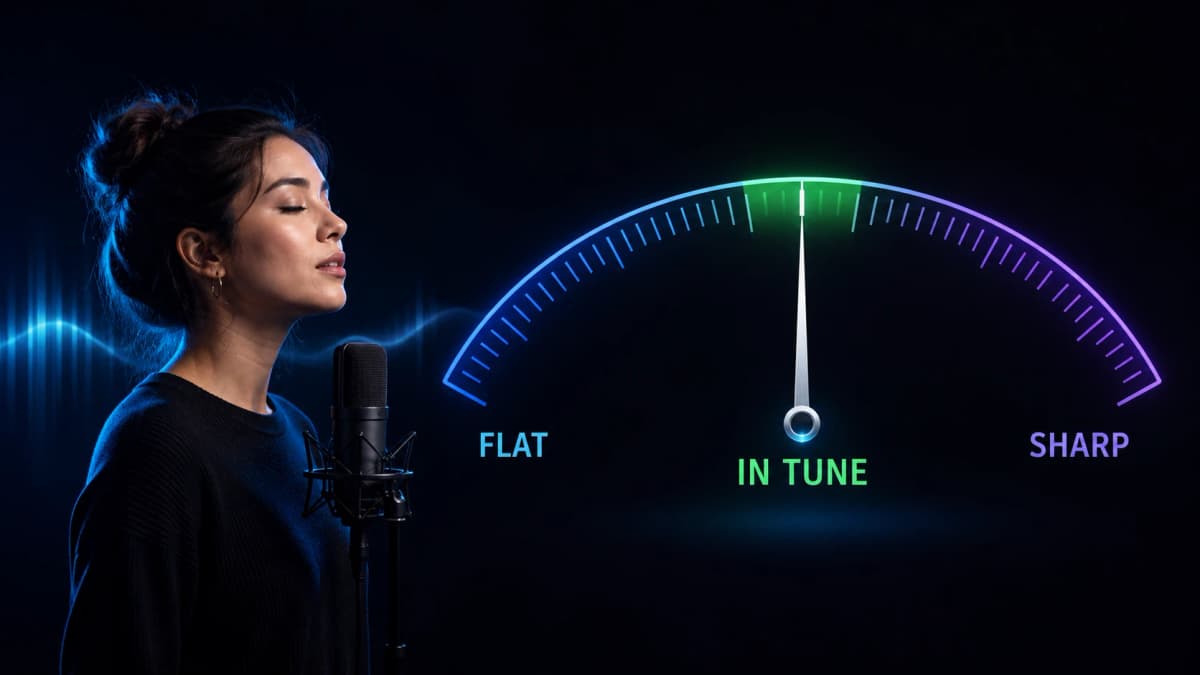
Why your ear lies to you
It's a physical problem more than a confidence one. When you sing, some of what you hear reaches your inner ear through the bones of your own skull, not only through the air, and that bone-conducted sound mixes in extra low-frequency content that a listener never hears. It's the same reason a recording of your own voice can sound surprisingly different from what you hear while singing it. The exact cause is still debated (research shows own-voice pitch perception is more complex than bone conduction alone), but the practical effect is simple: until your ear is trained, your internal sense of your own pitch isn't a reliable measurement. A reliable inner ear is something training builds. You don't start with one.
And it's measurable, not just a feeling. When researchers measured singing pitch accuracy, untrained singers landed noticeably further off the note than trained ones: around 34 cents off on average, versus about 25 cents for professionally trained singers. The encouraging part of that same study is that pitch inaccuracy decreases as training increases. So an untrained ear really does misjudge pitch more, and that gap narrows with practice. If your ear was never trained by ear-training or one-on-one correction, a note can genuinely feel right while it's actually sharp or flat.
One quick clarification before the test. This is about pitch accuracy, meaning how close you land to the correct note. It's not the same as vocal range, which is your lowest and highest notes overall. If you haven't measured that yet, find your vocal range separately; the two checks answer different questions.

My own experience with this
I was, honestly, a bad singer and a bad learner. My ear wasn't trained, so I couldn't tell on my own whether a note was correct or not. It just didn't work that way for me. I did have a singing teacher, but the classes were taught in a group setting, not one-on-one, so she wasn't able to catch or correct my individual pitch mistakes. There was no one telling me, in the moment, that a note was flat.
What actually helped was a tuner. Not because it's magic, but because it gave me an outside reference my own ear couldn't provide. That's still exactly what I use today: if I want to know whether I'm actually on pitch, I open the Vocal Tuner and sing into it to check.
The 5-minute self-test
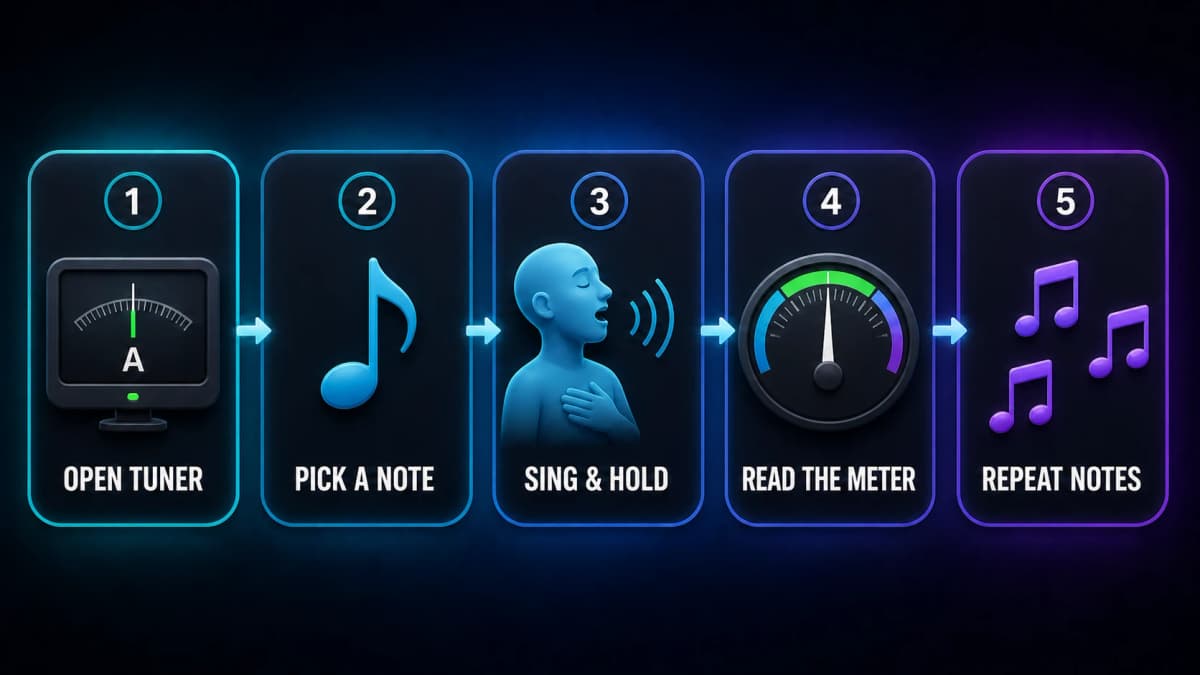
Here's the test, exactly as I use it:
- Open Singers AI Vocal Tuner.
- Pick one note or a short phrase, either from a song you're working on or just a comfortable sustained note.
- Sing it and hold it steady for a few seconds while watching the meter.
- Read what the meter shows before you decide anything about the note yourself.
- Repeat on two or three different notes or passages, not just one, since a single lucky note doesn't tell you much about the rest of a song.
That's it. Five minutes is enough to get an honest read on a handful of notes, which is usually enough to notice a pattern, like always going flat on higher notes, or sharp on a specific passage.
If you want the reference note and scoring in one guided browser exercise, try the free online singing pitch test. It plays a note, gives you time to sing it back, and scores that attempt. If you want to identify one note you are singing right now instead, use the free Pitch Detector.
What the meter is actually telling you
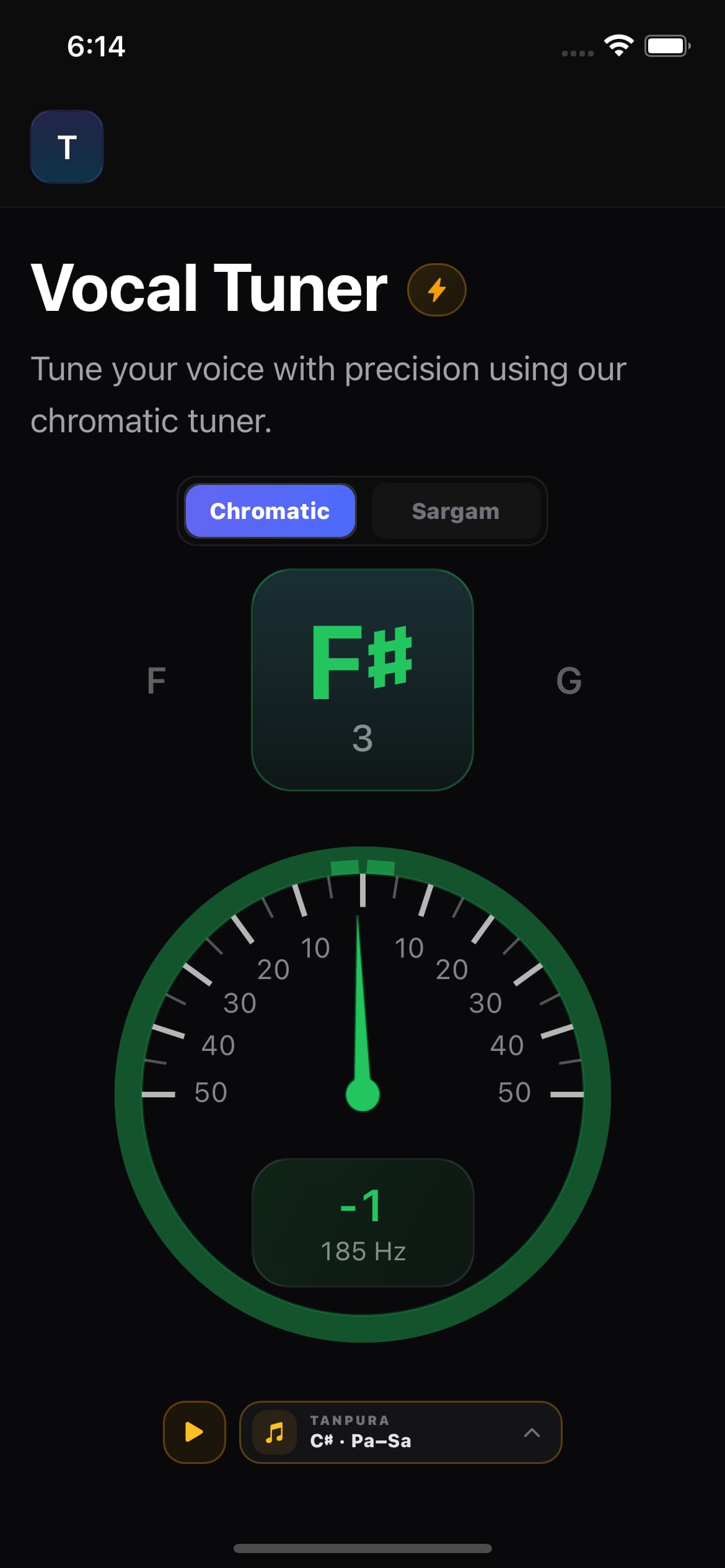
The Vocal Tuner shows your pitch as a needle on a ±50 cent meter, with tick marks every 10 cents, plus the frequency in Hz and the note name. A cent is a small fraction of a semitone, so this is a far more precise reading than "close enough by ear."
The meter turns green once you're within about 5 cents of the correct pitch, and it stays green until you drift past about 8 cents off. That small buffer keeps a genuinely steady note from flickering in and out of green over tiny natural wobble. If you see drift arrows appear, you've been drifting sharp or flat for a moment, not just a passing wobble.
One thing the tuner does not do: it does not auto-tune or correct your voice in any way. It only shows you where your pitch actually is. What you do with that information is up to you.
Going further: practicing a scale against a reference note
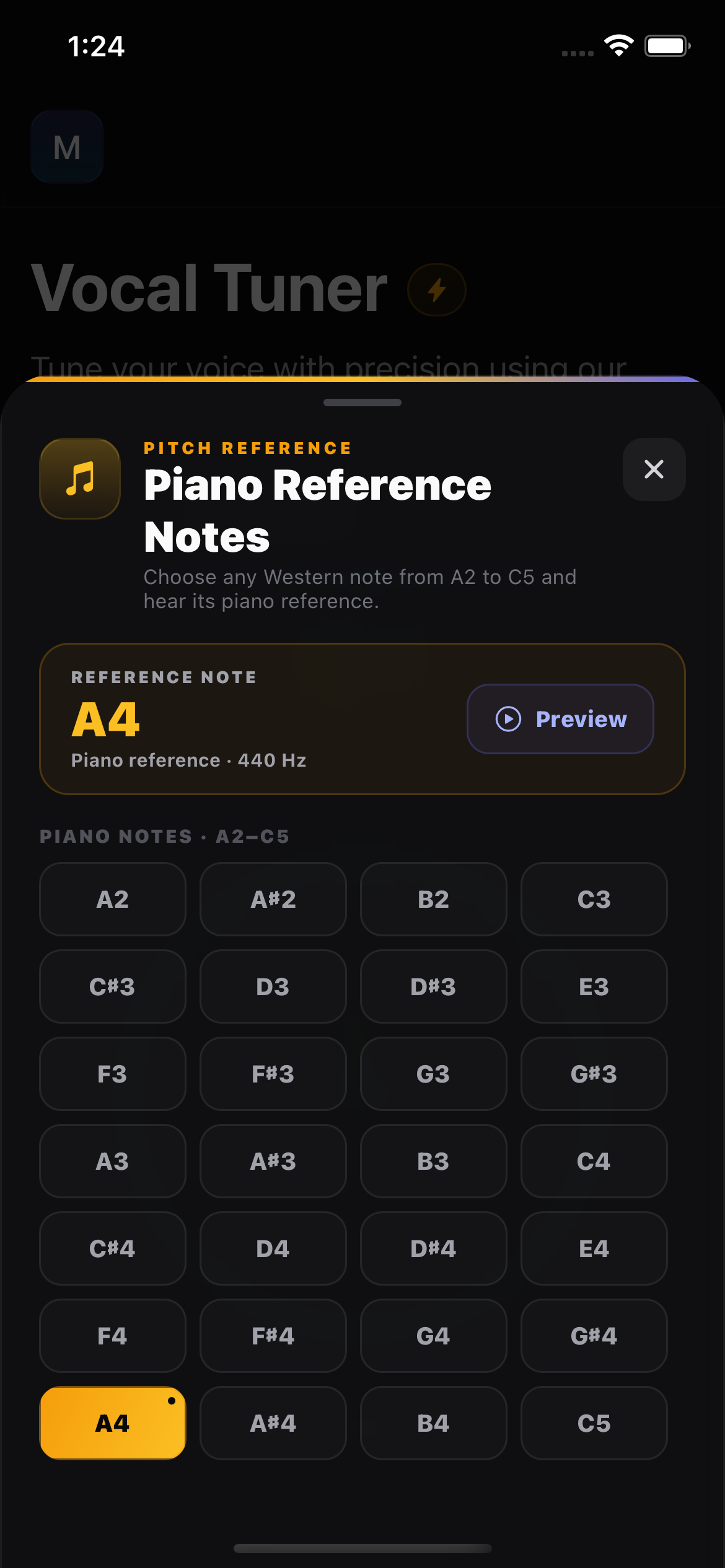
Checking one note is useful, but it's not how I actually built up my accuracy over time. The Vocal Tuner also has a reference tone: piano samples you can play as a fixed pitch to sing against, for example a note like C#3.
What I actually do: pick a reference note, play it, then sing a full scale starting from that note, checking each note against the meter as I go. This turns the single-note check into a real practice routine. Instead of just confirming whether one note was okay, you get a pass through several notes in a row and can see exactly where your accuracy breaks down, not just whether it does. This is the method that actually improved my pitch accuracy over time, more than checking one note ever did.
For shorter ear-to-voice drills, the Pitch Training Games feature turns pitch practice into focused rounds.
The common mistake: trusting "it sounds right to me"
If there's one thing I'd tell an earlier version of myself, it's this: "it sounds right to me" is not proof, especially with an untrained ear. I used to think a note was fine simply because it didn't feel wrong while I was singing it, and I was often wrong. Because you don't hear your own voice quite the way a listener does, a note can feel correct inside your head while landing noticeably off, and the less trained your ear, the wider that gap gets. Until your ear catches up, checking against something outside your own head isn't a lack of confidence. It's the surest way to know.
Try it yourself
You don't need to already believe you have a "good ear" to run this test. That was never true for me either. Open the Vocal Tuner, sing a note, and let the meter tell you what's actually happening.
Find out for sure, not just what feels right.
Open the Vocal Tuner, sing a note, and let the meter tell you what your ear can't.
Explore Vocal Tuner