How to Find Your Vocal Rangeand see your voice type on a range chart
Your vocal range is the span between the lowest and highest notes you can sing cleanly. Measure both ends, understand what they mean, and use the result to choose song keys that feel natural.
Try the free Vocal Range Test
Sing into your browser, no sign-up. It names your lowest and highest note and your total range.
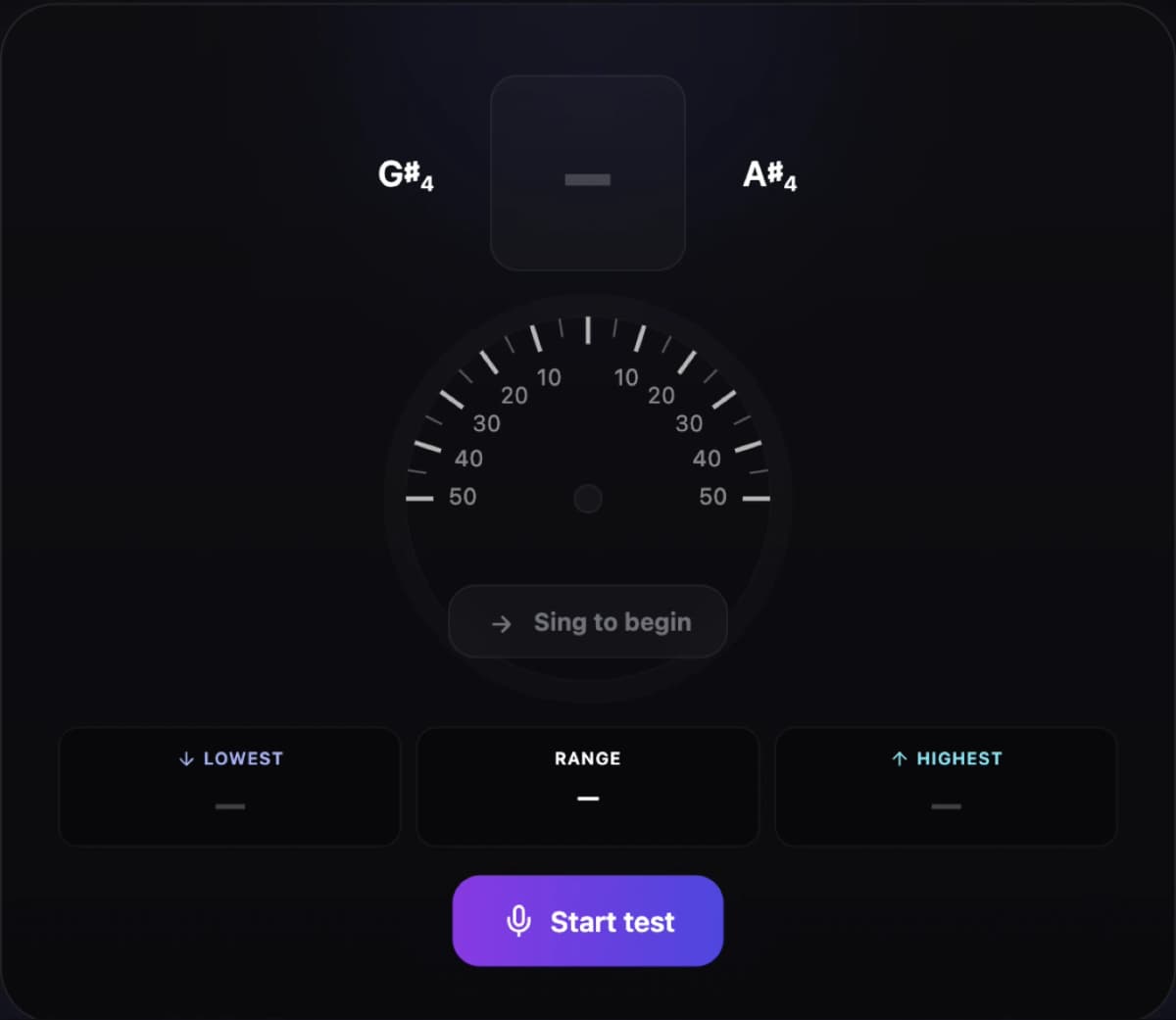
The short answer
Warm up, sing your lowest comfortable note, then your highest clean note. A free range test reads out both pitches; the distance between them is your vocal range. Repeat it on a few days and use your comfortable result, not a strained extreme, when choosing song keys.
The fastest way: a free browser vocal range test
You don't need a piano or a music degree. A browser tool listens through your microphone, shows the note you're singing, and remembers your extremes as you go. Here's the whole process:
Want a guided routine first? Follow our five-minute vocal warm-up before singing before measuring your range.
- 1
Warm up for a minute or two.
A cold voice under-reports both ends of your range. Do a few gentle slides before you measure.
- 2
Open the tool and allow microphone access.
It runs entirely in your browser. Nothing is uploaded, and there is no sign-up.
- 3
Sing your lowest comfortable note and hold it.
Hum or sing an "ah" and let it settle for about a second so the reading locks in. Go as low as you can while the tone stays clear, not creaky.
- 4
Glide up and hold your highest clean note.
Slide up to the top of your comfortable voice and hold. Counting a strained squeak is not useful; aim for notes you could actually sing in a song.
- 5
Read your lowest, highest, and total range.
The tool shows both notes (e.g. G2 and E4) and the span between them in octaves and semitones.
A quiet room and, if you have them, headphones will give you a cleaner reading. Do it two or three times and take the widest clean result.
How to find your vocal range by ear
No tool handy? You can map your range with any piano or keyboard app, or a tuner app that reads back the pitch you sing. Start on a comfortable note in the middle of your voice, then:
- Walk down one semitone at a time, matching each note, until the tone gets breathy, creaky, or disappears. The last clear note is the bottom of your range.
- Return to the middle and walk up one semitone at a time until you can no longer sing cleanly without straining. That clear top note is your ceiling.
- Write both notes down with their octave numbers, for example A2 at the bottom and D4 at the top.
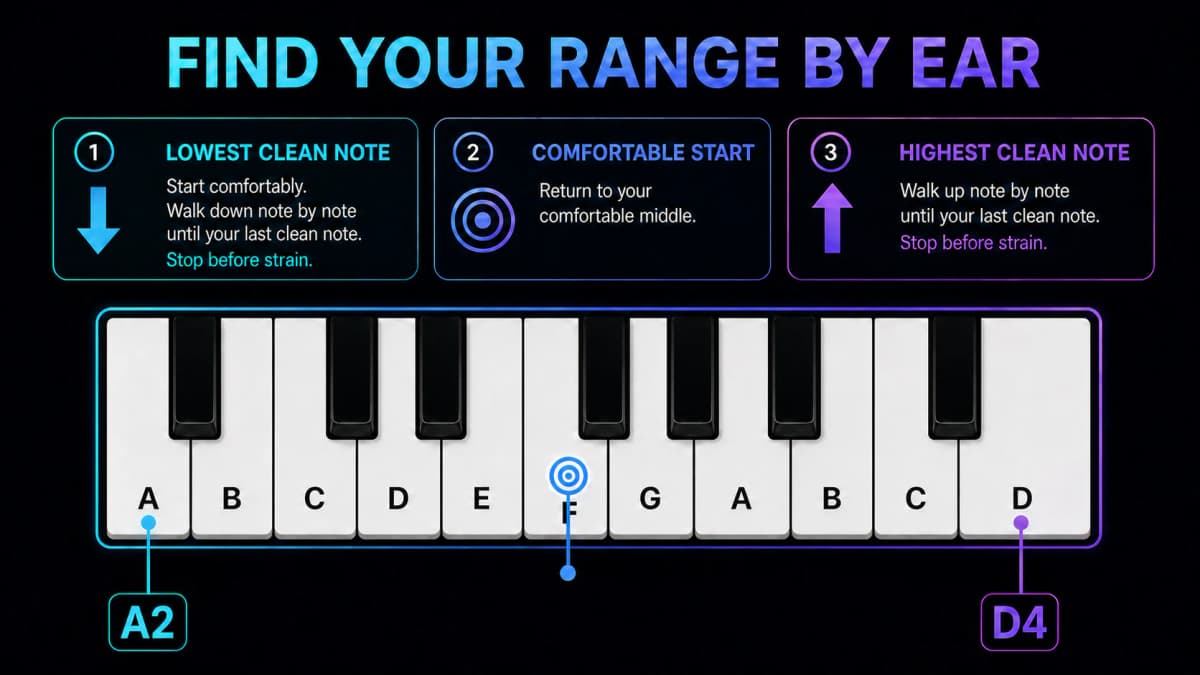
Reading note names: every note has a letter (A–G, sometimes with a ♯ or ♭) and an octave number that ticks up one at every C. Middle C is C4. A semitone is the smallest step between two notes: one key on a piano, black or white, and twelve of them make an octave. So a range written as “A2 to D4” means from the A two octaves below middle C up to the D just above it.
Keep your comfortable range and your full range (including breathy head voice or falsetto) separate in your notes. Both are useful, but the comfortable range is what you'll lean on when you choose songs.
What your vocal range tells you (and what it doesn't)
Range is usually described in octaves and semitones. Most people, untrained, land somewhere around one and a half to two octaves, and that grows with steady practice. But the headline number matters less than knowing where your range sits on the keyboard, because that's what decides which songs and keys feel natural.
What voice type does your range suggest?
I found this out the hard way. I tried to sing Ed Sheeran's “Perfect” the way it's originally written, in G, and I couldn't hit the high note at that scale. I write about what I actually did with the key itself in how I later practised this song.
At first I thought it just meant I hadn't practiced enough. So I looked into it properly, and found two things that were both true at the same time. Vocal range really is a physical difference between singers; it isn't something everyone reaches with enough effort. Voice science backs this up: your range sits within limits set by your vocal folds and how your voice naturally resonates, and those really do vary from person to person. But the second thing matters just as much: practicing the right technique, like mixed voice, is a well-established way to get more out of the range you actually have by smoothing the join between chest and head voice. Neither one cancels the other out. Knowing my range didn't mean giving up on getting better. It meant I stopped comparing myself to someone else's voice and started working with mine.
So I measured mine properly. My lowest note is F2, my highest is F#4. Compared against the usual chart, that puts me closest to Baritone.
Your lowest and highest notes hint at a voice type, the rough family your voice sits in. The typical ranges below are a starting point; read the caveat underneath, because it matters more than the label.
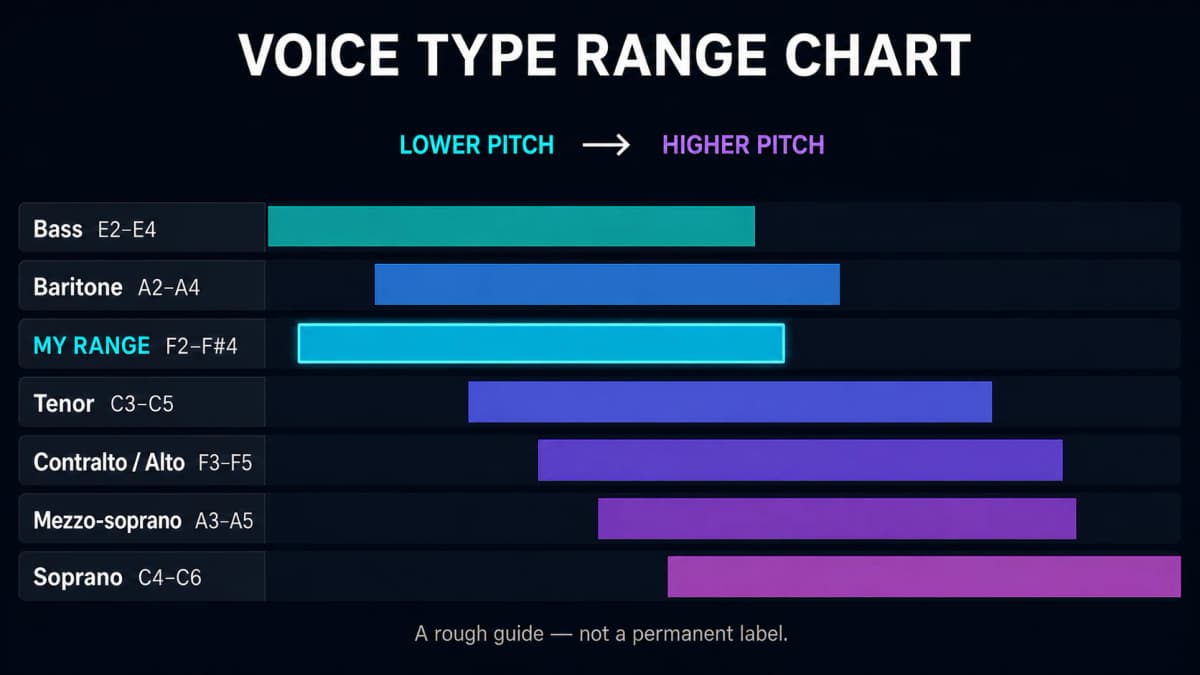
My own range, F2 to F#4, sits closest to the Baritone row above, which is why I used it as the example.
Treat these as a rough guide, not a verdict. Real voices overlap the textbook boundaries, the exact ranges vary between teachers and traditions, and warm-up, health, and training all move your edges. Plenty of singers sit between two types, and where your voice feels comfortable matters more than the widest note you can reach. A range test is a snapshot of your voice today, not a permanent classification, and it doesn't decide which songs you're allowed to sing.
Use your range to pick keys that fit your voice
Your range is only half of the comparison. First establish the recording's starting point with the guide to changing a song's key to fit your voice, then test the complete song before choosing your performance version.
This is where knowing your range pays off. Every song's melody has its own lowest and highest note. If those sit outside your comfortable range, the song fights you: you either bottom out on the low notes or strain for the high ones. The fix is to change the key so the melody slides into your range.
Once you know your lowest and highest notes, compare them with a song's melody range. If the song sits too high, move it down; too low, move it up. In the Song Practice Workspace you can shift a track's key by up to six semitones in either direction and practise at that key until it feels comfortable, then check yourself against the vocal tuner to make sure you're landing the notes. You decide the key that fits; the tools just make the transposing and practising easy.
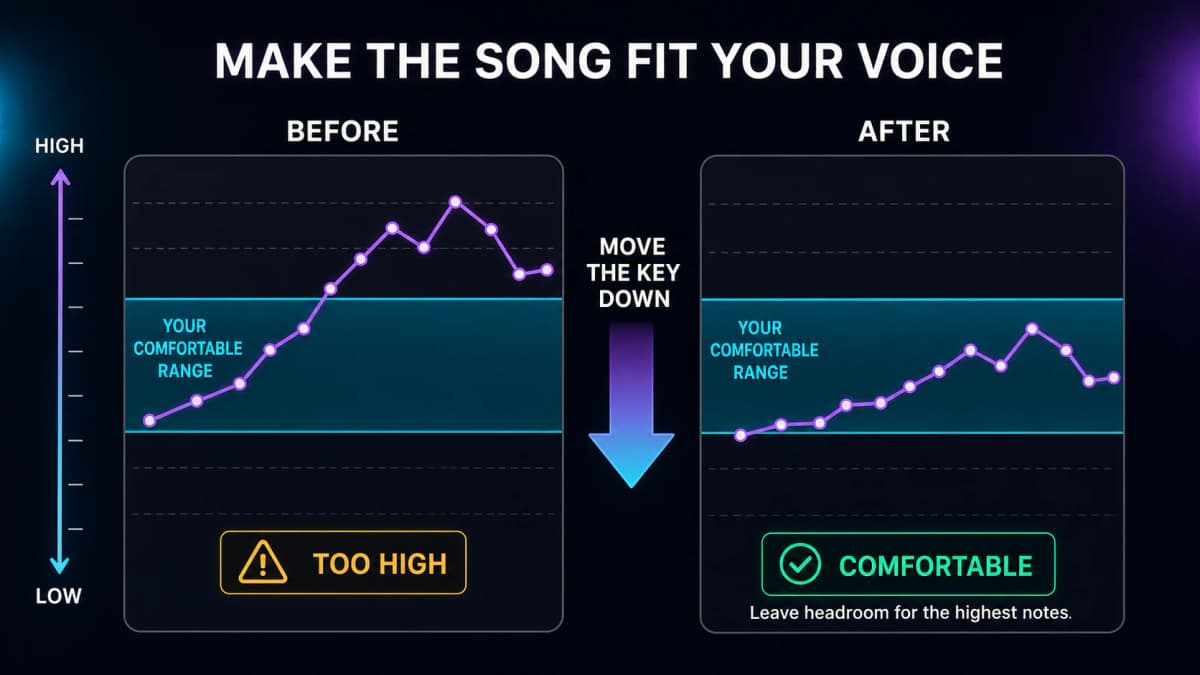
Rule of thumb: aim for a key where the song's highest note lands a little below your ceiling, so you have headroom for the loud moments, and its lowest note stays above your floor, so the low lines still carry.
Frequently asked questions
How do I find my vocal range at home?
Warm up first, then sing your lowest comfortable note and your highest, and note the two pitches. A free vocal range test identifies each note for you; the distance between them is your range.
What is the average vocal range?
Most untrained singers span roughly one and a half to two octaves. Training and warming up can widen that, but the exact number matters less than knowing where your range sits so you can pick keys that fit it.
How many octaves should I be able to sing?
There is no "should." Comfortable, healthy singing across your natural range matters far more than octave count. Plenty of singers work happily within about two octaves and simply choose songs and keys that suit that span.
Does my vocal range change over time?
Yes. Range shifts with warm-up, time of day, sleep, health, and practice, so treat any single reading as a snapshot rather than a verdict. Re-test on a few different days for a fuller picture.
Find your range, then make it count.
Measure your lowest and highest note free in your browser, then use the Singers AI vocal tuner and practice workspace to sing in keys that fit you.