
5-Minute Vocal Warm-Up Before Singing
Start gently before daily practice, recording, an audition or a live performance. Begin from one comfortable note, then move through four simple patterns without forcing your voice.
Start the guided warm-up
Choose a comfortable note, then follow the four piano-led exercises in your browser.
The short answer
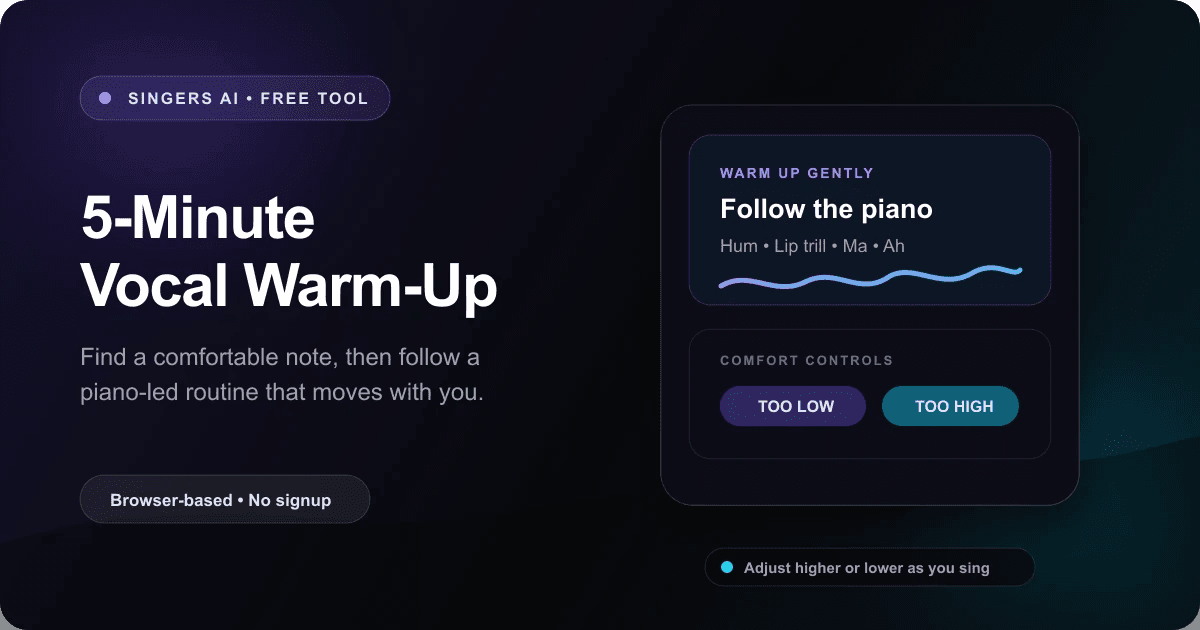
With five minutes before singing, start from a comfortable note and move through gentle humming, lip trills, “Ma,” and a gentle “Ah” pattern. Keep the sound easy, and move the routine lower or higher if the current pattern does not feel comfortable.
What my vocal teacher helped me understand
I did not always treat warm-ups as an important part of singing. My vocal teacher helped me understand their importance. Before that, I might begin practising without giving my voice a gradual start.
The comparison that stayed with me is the gym. You do not usually begin heavy lifting with your heaviest weight as the first movement. You prepare your body and build into the work. I began thinking about vocal practice in a similar way: start in a comfortable range, then move towards more demanding singing progressively.
That is my experience and analogy, not a medical rule. The practical lesson for me was simple: a few gentle exercises made more sense than starting a demanding session cold.
The four-part five-minute routine
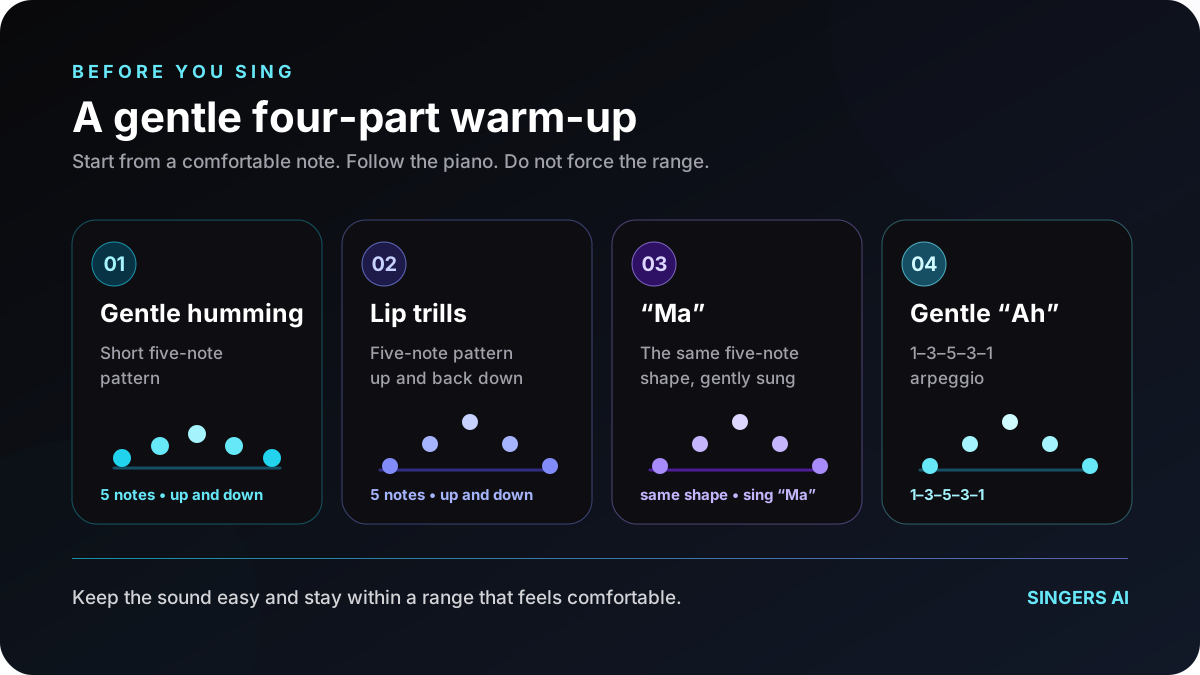
Use a comfortable starting note and follow these four exercises:
- 1
Gentle humming
Hum quietly on a short five-note pattern:
Sa–Re–Ga–Re–Sa. - 2
Lip trills
Let the lips vibrate freely while you move through a five-note pattern up and back down.
- 3
“Ma”
Sing “Ma” on the same five-note shape, matching the piano reference without pushing.
- 4
Gentle “Ah”
Finish with a gentle
1–3–5–3–1arpeggio.
Exercise 1: gentle humming
Humming is the easiest place for me to begin. Keep it quiet and comfortable, and follow the short pattern without trying to reach an extreme note.
Notice whether the sound feels easy. You do not need to make the hum loud or push it higher to make the exercise worthwhile. If you feel pressure, back off or stop.
Professional voice guidance discusses humming among commonly used voice exercises, but the right exercise and amount of practice can differ between singers. Read the ASHA voice guidance and the National Association of Teachers of Singing warm-up resource for professional context.
Exercise 2: lip trills
Lip trills are especially useful when I need a quick warm-up before an audition or performance. Let the lips vibrate while you move through the piano pattern. Keep the effort light and let the note come to you rather than pushing it into place.
If your lips stop vibrating, reduce the effort and return to a comfortable note. The purpose is not to sing as loudly or as high as possible. It is to continue the pattern without unnecessary force.
Exercise 3: “Ma”
After humming and lip trills, the routine moves to “Ma” on the same five-note shape. Sing the syllable clearly but gently, matching the piano reference.
This is still a warm-up, not the point where you test your full vocal range. Stay with the comfortable starting point. If the pattern feels too high, use Too High to move it down. If it feels too low, use Too Low to move it up.
Exercise 4: gentle “Ah”
The final exercise uses a gentle “Ah” on a 1–3–5–3–1 arpeggio. Follow the piano one note at a time and keep the sound relaxed.
Do not turn this final pattern into a challenge to see how high you can go. The routine is meant to prepare you for the singing you are about to do, not replace it or decide how much you can sing today.
Choose the starting range that feels comfortable
The starting note matters because a fixed routine does not feel the same to every singer. A note that feels easy for one person may be too high or too low for another person that day.
In the Singers AI Vocal Warm-Up, you can hold one steady note for local calibration or choose a piano note manually. The detected note is only a starting anchor. It is not a measurement of your complete range, a voice-type verdict, or a decision about what is medically safe.
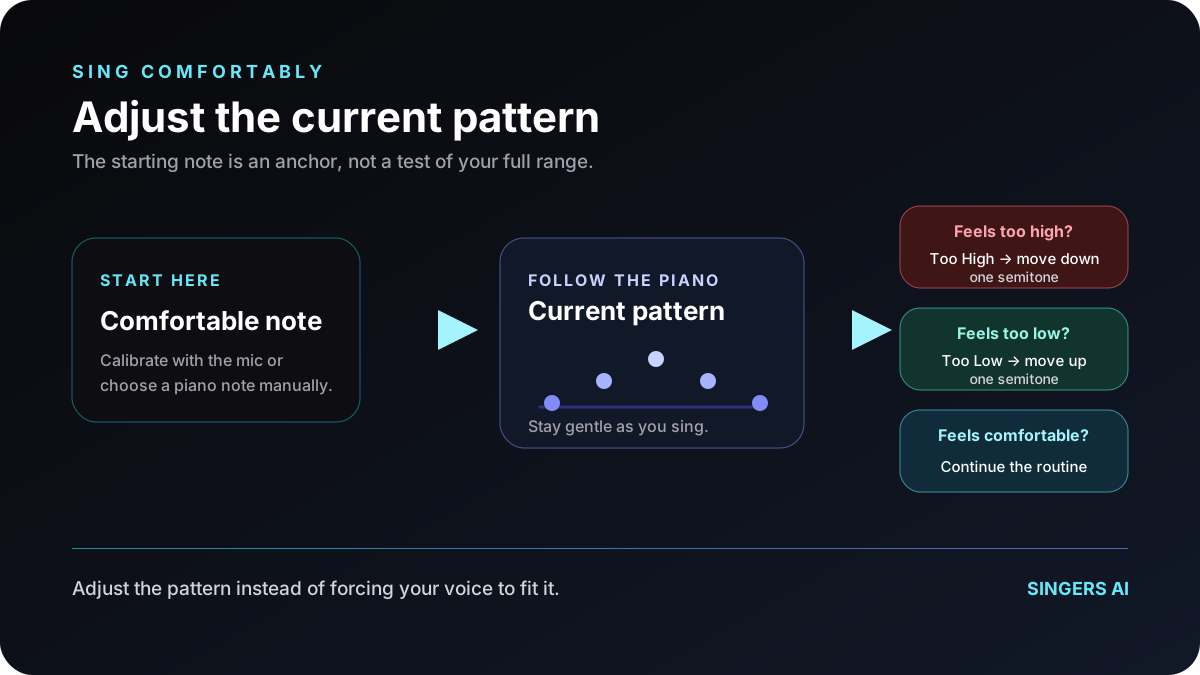
If you are using the tool with a microphone, calibration is optional. You can choose a note manually and complete the routine without microphone access. The tool processes microphone pitch on your device and does not record, upload, or store your audio.
When to use this routine
Before daily practice
Use the routine as a gradual entry into a longer session. Once the warm-up ends, begin your practice with work that matches how your voice feels that day. Do not treat the five minutes as permission to force difficult notes immediately afterwards.
Before recording
A short routine can help you arrive at the recording session with a consistent preparation habit. Keep the warm-up comfortable and leave enough time to set up your recording environment without rushing.
Before an audition
This is where lip trills helped me most. When time was limited, a quick gentle warm-up helped me feel more prepared before singing. It did not guarantee a result; it simply gave me a way to begin gradually.
Before a live performance
Use the same principle before performing: start comfortably, move through the four patterns without forcing, and then sing a short easy phrase if that is part of your preparation. The first song or passage should not be the first demanding sound you make that day.
The common mistake: treating warm-up like a test
It is easy to turn a warm-up into another challenge. You may start comparing your highest note, adding volume, or pushing through a pattern because you want to prove that you can do it.
That misses the point. A warm-up should help you begin with control and awareness. It is not a score, a range test, or a prediction of how your performance will go.
If singing causes pain or persistent strain, stop. This routine does not diagnose a vocal condition or determine whether your voice is safe. Seek advice from a qualified voice professional or healthcare professional when you need individual guidance.
Try the guided warm-up
Start with one comfortable note, follow all four exercises, and adjust the current pattern whenever it feels too high or too low.
Start the free Vocal Warm-UpContinue with related singing guides
After warming up, use these guides to check your pitch and understand the notes that fit your voice.
Sources
- ASHA Practice Portal: Voice Disorders — professional context on voice exercises; this article does not present the tool as voice therapy.
- National Association of Teachers of Singing: The Five Best Vocal Warm-Up Exercises — professional pedagogy context on commonly used warm-up exercises.