
What Is Sargam? Sa Re Ga Ma, and How to Actually Sing It
Sargam is the Indian way of naming the seven musical notes you sing: Sa, Re, Ga, Ma, Pa, Dha, Ni, and then back to Sa an octave higher. It is the Indian counterpart of the Western “Do Re Mi.” Singers practise these swaras first, before songs, to train the voice and the ear to land each note cleanly.
That is the short answer. But knowing the names is not the same as being able to sing them in tune, and that second part is where most beginners get stuck. This is how I actually learned to do it.

Why singers learn sargam before songs
When I started, I did it the wrong way around. I tried to sing full songs straight away, without fixing a single note underneath them. My teacher stopped me and told me to learn sargam first.
It made sense once I did it. A song is dozens of notes moving quickly. If you cannot reliably hit one clean note, you cannot hit fifty of them in a row inside a melody. Sargam slows everything down to one note at a time, so you can actually fix your pitch before you ask your voice to do anything complicated. It is the foundation, and songs sit on top of it.
The seven swaras
The full set is seven notes, sung in order:
Sa · Re · Ga · Ma · Pa · Dha · Ni, then Sa again one octave up.
In Indian classical music these are the shuddha (natural) swaras. Some of them also have altered versions: Re, Ga, Dha and Ni can be komal (flat), and Ma can be tivra (sharp). Sa and Pa never change. Sargam works the same way Western solfège does, just with different rules for those alterations.
If you are a beginner, do not worry about komal and tivra yet. Learn the seven natural swaras first and get them clean. That is what I did, and the altered notes came much more easily later, after about a month of fixing the normal ones.
Find your Sa
Here is the part that surprises people: Sa is not a fixed note. You choose it. Once you pick your Sa, the other swaras follow from it, but the starting pitch is yours.
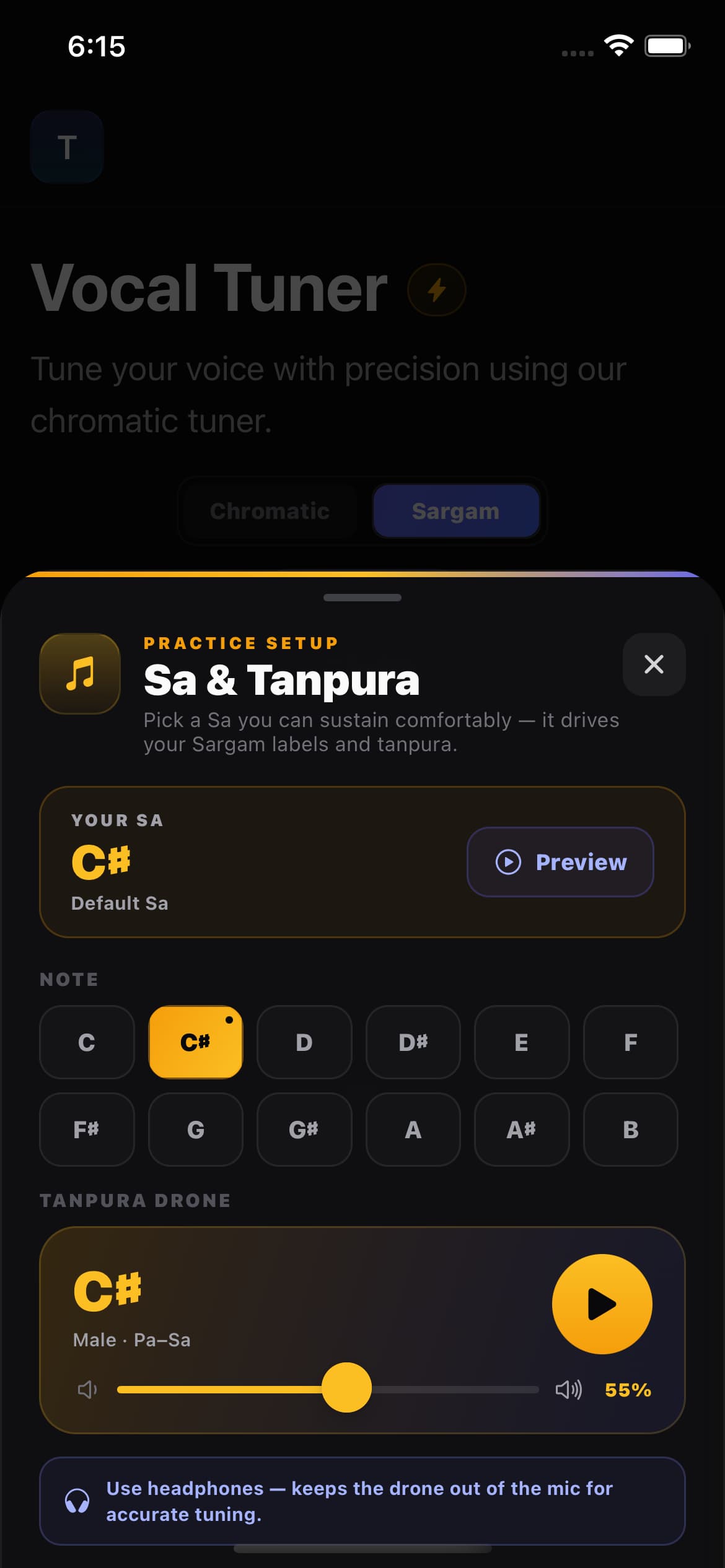
Pick a Sa that sits comfortably in the middle of your voice, low enough that you are not straining and high enough that it is not a mumble. A common starting point is C♯3, which is also the default Sa in the Singers AI Sargam & Tanpura feature. Higher voices often settle on a higher Sa. There is no single "correct" Sa; there is the one that fits your voice.

The C♯3 scale on the tuner
To make this concrete, here is what the seven swaras look like when your Sa is C♯3. These are the Western note names your tuner will show:
| Swara | Sa | Re | Ga | Ma | Pa | Dha | Ni | Sa |
|---|---|---|---|---|---|---|---|---|
| Note | C♯3 | D♯3 | F3 | F♯3 | G♯3 | A♯3 | C4 | C♯4 |
This is only an example to help you use the tuner. You do not need to memorise Western note names to sing sargam. But seeing "Re should read D♯3 on the meter" gives you something exact to aim at while you are still training your ear.
How to actually practise it: drone plus tuner
This is the method that worked for me, and it is the whole reason I could finally hit the notes.
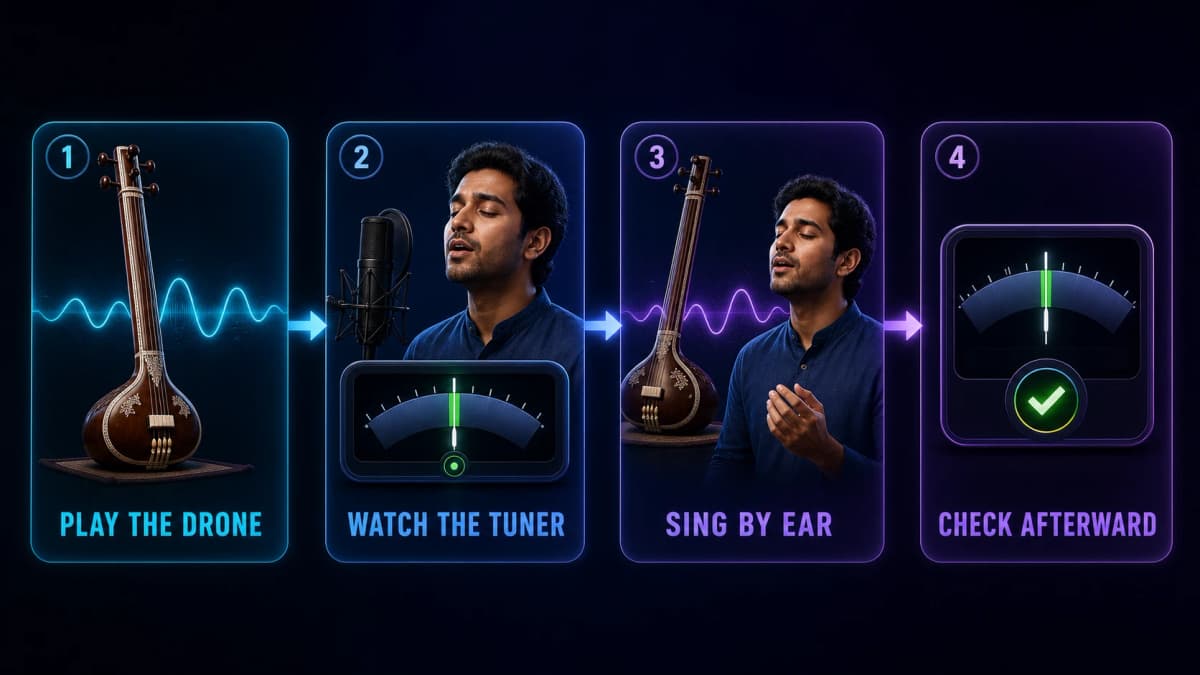
- Put on your earphones and play the Tanpura drone on your Sa. The drone holds your Sa constantly so your ear always has a reference underneath you.
- Sing one swara, starting with Sa, and hold it.
- Watch the tuner meter while you hold the note. It shows you exactly where your pitch is landing, sharp or flat.
- Raise or lower your voice slightly until the meter says you are on the note. Then move to Re, and do the same.
Before Singers AI, I did this with a separate app for the Tanpura and a tuner next to it. Now the drone and the meter are in one place in the Sargam & Tanpura feature, so I am not juggling two apps.
The tuner is what made the difference for me. Early on, singing with just the drone and my ears, I honestly could not tell whether I was on the note or not, because my ear was not trained yet. The meter showed me the actual situation. I did not have to guess. I just moved my voice until the reading was correct, and over time my ear started to remember where each note was.
Tuner first, then your ear
The goal is not to stare at a meter forever. It is to use it as training wheels until your ear catches up.
After some days of practising each swara against the tuner, I started closing my eyes and singing the same notes with only the drone, then checking afterwards. More and more, I was right. That is when it turned into real confidence. The tuner had trained my ear to the point where I did not need it in the moment anymore.
So the progression is simple: tuner first to fix the notes, then your ear once it knows them. For me the natural (shuddha) swaras came first, and once those were solid, the komal and tivra notes were much easier to add.
A simple 15-minute daily routine
You do not need long sessions. About fifteen minutes a day on your Sa scale is what gave me real improvement, in both my voice and my ear.
A basic routine:
- Play the Tanpura on your Sa and sit with the drone for a few breaths.
- Sing up the swaras slowly: Sa, Re, Ga, Ma, Pa, Dha, Ni, and up to the higher Sa, checking each one against the meter.
- Come back down the same way, from the higher Sa to your starting Sa, and stop there.
- On the days it feels steady, drop the meter for a round and test your ear.
Do not force the low notes. Going below your Sa is hard when you are starting out, and that is normal. If you can reach down to the lower Ma, which is F♯2 when your Sa is C♯3, that is already good. You do not need to force anything lower while your low range is still developing.
Short and daily beats long and occasional. The point is to fix each note, not to rush through all seven.
What comes next
Once you can sing the seven swaras up and down cleanly, the next step is alankars, the small patterns that move through the swaras in different orders and build real flexibility. That is a whole practice of its own.
If you want to understand the tuner meter itself first, the guide on whether you are singing in tune walks through reading it.
Set your Sa and start practising.
The Sargam & Tanpura feature keeps the drone and the pitch meter in one place, so you can fix each swara as you sing it.
Try the free Online Tanpura Explore Sargam & Tanpura